The GRIM-L1ns are the Citadel's hands: synthetic enforcers the warden pushes onto a floor when it decides you've become interesting. On paper they're the connective tissue of the whole PvE layer. In the last build they were the weakest link: they spawned on rails, they fought the same everywhere, and half the time you couldn't tell one from another squad's Revenant until you'd already hesitated. We rebuilt two things.
01Spawning that reacts to you
The old spawner was a timer with a map attached. L1ns arrived on a schedule, in the same places, whether you were sprinting through guns-up or crawling a corner at a time. It meant the smart play was always the same play, and the tower never felt like it was watching.
The new spawn director is reactive. It reads three things about you, continuously, and decides where pressure should come from:
- Position & pace. Where your squad actually is, and how fast you're moving through the floor, so L1ns arrive as a response to your route, not from a fixed closet you've already memorised.
- Progression. How far you've climbed, what your loadout is worth, how deep into the run you are. A stacked squad three floors from the Pinnacle draws a very different response than a fresh insert in the Farm.
- Noise. Gunfire, breaches, forced Riot Doors: anything that raises your heat with GRIM. Play loud and the building answers louder.
The point isn't to make them harder. It's to make them legible in the fiction: the L1ns are the Citadel noticing you. Push fast and loud, and you feel the tower push back. Sit and farm a floor quietly, and it stays tense but lets you work. Same encounter budget as before; it just arrives in response to how you're playing instead of when the clock says so.
Reactive doesn't mean unfair. The director still respects hard rules: no spawns inside your vision, no teleporting behind a held angle, a floor on the L1n count. We tune the where and when, never cheat the whether you could have seen it coming.
02Know it on sight
Here's the problem that cost more players a run than anything else: in a dark corridor, a GRIM-L1n and another squad's Revenant looked too much alike. You'd catch a silhouette, freeze for a fraction of a second to work out whether it was AI or a person, and that fraction is the whole game. Sometimes you burned a player you thought was a L1n. More often a L1n burned you.
So we gave the L1ns a visual language that a real player can never wear. It starts with the eyes.
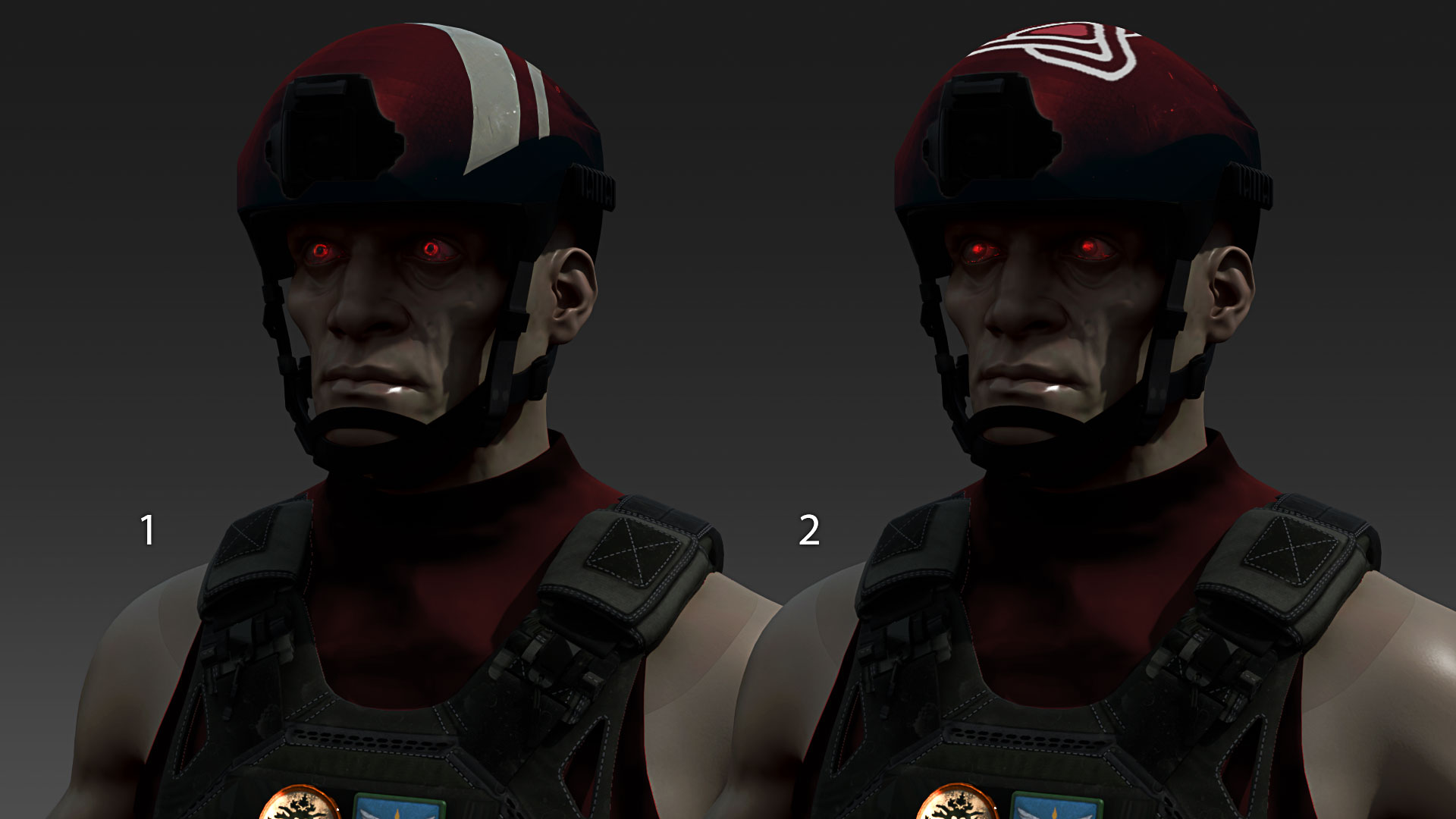
The eyes are the rule. Every GRIM-L1n now carries a hard red ocular glow, a colour we've fenced off from every player customisation option in the game. It reads in a blackout, it reads through smoke, it reads at the edge of your nightvision. The doctrine we're standardising on is simple enough to say in the tutorial and never explain again: if the eyes glow red, it isn't a player.
On top of that we're colour-coding their kit: the helmet decals, the patches, the trim, so that once you know it's a L1n, you can read which L1n it is at a glance. The two heads above are the current iteration of that pass: same red signature, different unit markings. Variant 2's emblem is winning our internal reads for legibility at distance, but that's exactly the kind of thing we'd love the beta to argue with us about.
You should never lose a fight because you weren't sure what you were looking at.
Between the two changes, the L1ns finally do the job they were always meant to: they make the Citadel feel administered, not decorated. They show up because of something you did, and they announce themselves clearly enough that the only thing left to decide is whether you fight or slip past.
That's the loop closed for this build: the tower pays out, every advantage costs you, and now the building itself pushes back with something you can actually read. Get into the beta and break all three of these for me. Florent