The hardest question in an extraction game isn't where's the good stuff. It's why would you ever leave the floor you're standing on. If the answer is "you wouldn't," you don't have an economy, you have a queue. The Citadel is one Citadel. What we're tuning today is a slice of it: ten floors up, two cellars down, of a building that ships far taller. And a single rule runs the whole height of it. Risk and reward climb together, and neither one waits for you.
I want to walk you through how loot is actually distributed in the building, because the map only makes sense once you can see the money. None of these numbers are final; we retune every build. But the shape is the design, and the shape is stable.
One scope note before the charts. Everything in this log lives on the slice we're running right now: F−2 to F10. The full game experience runs F−2 to F41, all the way to the true rooftop. The bands below are how we think at any height; the building just gets taller.
01One building, five sections
We don't think about the Citadel floor by floor, let alone room by room. We think about it as five bands stacked on top of each other, each with a job. Your read on a raid is really a read on which bands you're willing to touch.
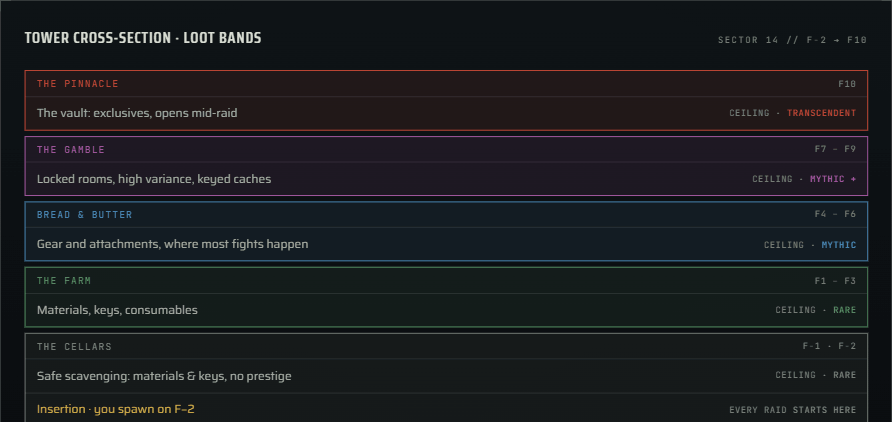
The Cellars are where every raid begins. You spawn on floor −2, so they're comparatively safe, and they will never, under our current ruleset, hand you anything above Rare. That's deliberate. New players and cautious runs need somewhere to build a bankroll without betting their life on the top of the building.
The Farm is where the Citadel's plumbing lives: crafting materials, consumables, and the keys that unlock everything above. Bread & Butter is the honest middle: it's where you'll take and win most of your fights, and where a good loadout actually comes together. The Gamble is exactly what it says. And the Pinnacle is a deterministic jackpot that opens once, mid-raid, and is contested every single time.
02Risk and reward climb together
Here's the spine of the whole system. The higher you go, the more the Citadel is holding, and the less likely you are to walk out with it. We tune two curves against each other: the raw value of what spawns on a floor, and your odds of successfully extracting from it.
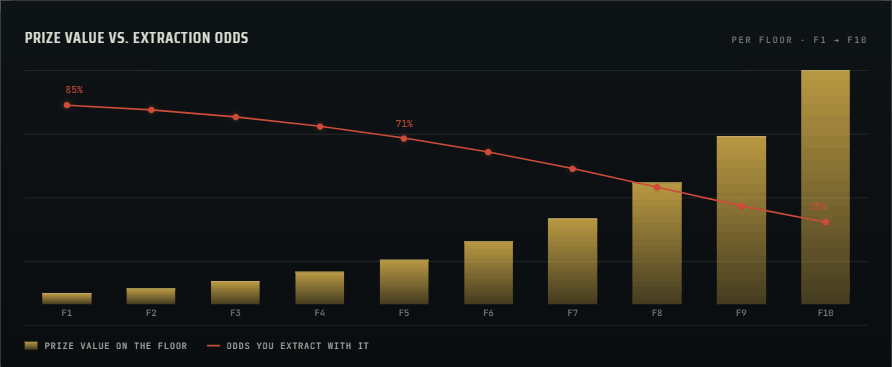
Multiply those two together and you get expected value, and here's the part people find surprising: a top-band raid is worth roughly twice a mid-band raid per run. Not per minute. Top raids take one and a half to two times as long and are far swingier, so the "premium" for climbing is really a skill premium, landing around 30 to 40 percent more per minute for players who can consistently convert time-in-danger into a clean extraction. If you can't, Bread & Butter quietly pays you more per hour than the Pinnacle does.
The Citadel doesn't punish greed. It prices it.
03Rarity has an address
A mistake we made early, and killed, was sprinkling a tiny chance of top-tier loot everywhere. It sounds generous. In practice it turns every container into a slot machine and makes the whole Citadel feel the same. So we gave prestige loot a home. Seven tiers, and each one has a floor it wakes on: Epic on F2, Legendary on F5, Mythic on F7, Transcendent on F9. Below that floor it simply does not exist.
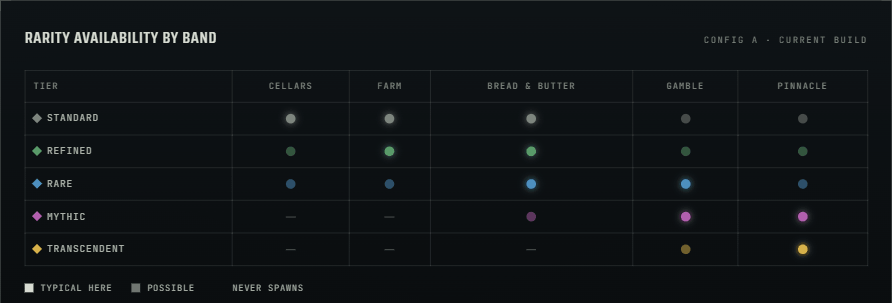
Now the map reads as intent. If you're hunting a Transcendent, you know you're going to the Pinnacle and you know what that costs. If you just need to rebuild a wardrobe of solid gear, Bread & Butter has your name on it. The rarity you want tells you which fight to pick.
Resolve those checks floor by floor and you get the distribution, the real tier mix of every container in the building. On F−2, where every raid spawns, a container reads about 83% Common, 15% Uncommon, 2% Rare. Thirteen floors up, at F10, the top of the current slice, the mix reads a third Rare, a third Epic and above. And nobody authored the humps in the middle: Uncommon peaks around F3, Rare around F8, then each gives way to the tier above it. Pure interpolation.
04Why the low floors still matter
The trap with a risk gradient like this is that veterans stop touching the bottom of the building entirely, and half your map goes dead. Two systems keep the Farm and Cellars alive for everyone.
Keys. The locked rooms in the Gamble, the ones with the fat, low-competition caches, open with keys that only drop down in the Farm and Cellars. So the richest players in the building still have a reason to spend two or three minutes sweeping the cheap floors on the way up. Loot flows down; keys flow up. The building circulates.
Materials. Crafting and repair inputs live low. If you want to keep running insured loadouts, you are constantly topping up on materials that the top of the Citadel simply doesn't drop. A Pinnacle god still needs the Farm's boring green crates.
We measure "band health" every build by the share of veteran runs that still stop in the Farm. When that number drops below a threshold, it's a bug in the economy, not player behaviour, and we retune key drop rates until the sweep is worth it again.
05What the Citadel keeps
All of this only has teeth because extraction is real. When you die, the building keeps what you were carrying, and the higher you climbed, the more that hurts. Insurance and contraband are how you decide, before you ever insert, how exposed you want to be.
An insured loadout claws a fraction of its value back and settles it off-ledger to your locker when you fall: a hedge against a bad run. Contraband carries zero recovery: pure upside, total exposure. On the low bands the difference barely registers. Carry a Mythic out of the Gamble uninsured, and the maths of your whole session is riding on one door.
Loot isn't a reward for showing up. It's the stake on a bet you keep choosing to make.
That's the economy in one breath: a building that pays more the higher you climb, charges you in survival odds for every floor, and never quite lets you ignore the cheap seats. If we've done our job, there's no dominant line through it: greed and discipline should both be able to win, and the interesting players are the ones who know which one this run calls for.
Next log, I'm getting into two systems that make the getting around as costly as the getting rich: Riot Doors, and how you choose to see in the dark. Florent